From 100 to 7,900+ Monthly Visitors: Scaling High-Intent Organic Traffic for a USA Law Firm
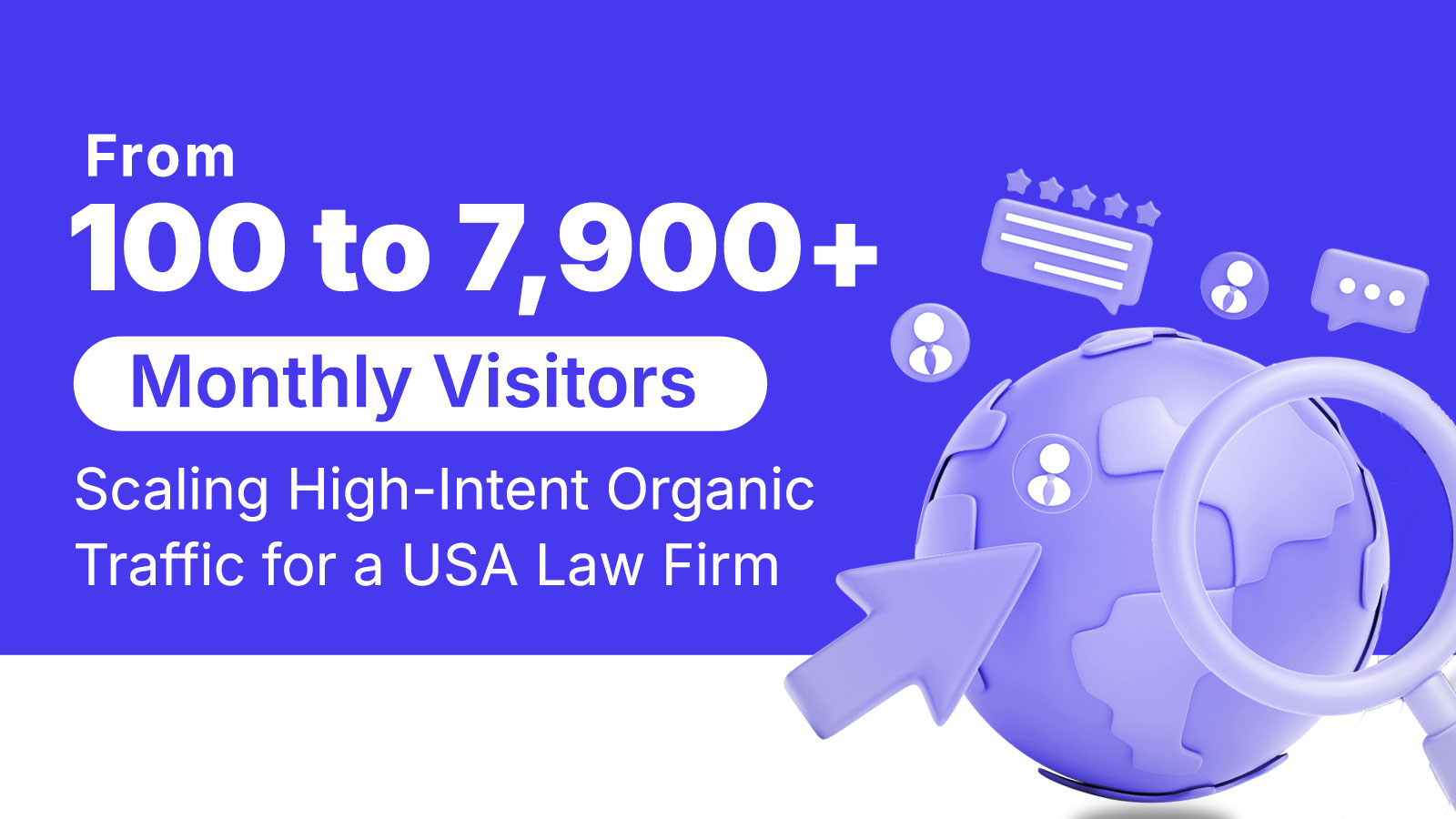
In January 2024, a USA-based law firm was receiving an average of 100 to 120 organic visitors per month. The firm was established and actively handling cases, but SEO had never been treated as a serious growth channel. The website contained basic practice area pages, limited authority signals, and little visibility for case-driven legal searches.
Over the next 14 months, organic traffic grew to 7,900+ monthly visitors. This growth was not driven by generic legal research or template searches. It came from high-intent, case-focused queries, including people actively looking for legal representation and jurisdiction-specific services. As traffic quality improved, organic search became a steady source of qualified inquiries, not just visits.
RESULTS SNAPSHOT
- Organic traffic grew from 100–120 to 7,900+ monthly visitors over 14 months
- Growth driven by case-intent legal searches, not templates or general research.
- Qualified inquiries increased steadily as practice area visibility improved.
- Core service keywords achieved stable first-page rankings.
- Topical authority strengthened through relevant legal and business backlinks.
- AI search visibility improved, increasing exposure for legal service queries.
Why Traffic Alone Was Never the Goal?
For a law firm, traffic without intent has no value.
The objective was never to attract users searching for free legal templates or broad legal definitions. Every SEO decision was guided by one question. Does this help the firm attract people who are likely to hire a lawyer?
Success was measured by:
- Visibility for service-driven legal searches
- Engagement on practice area pages
- Qualified inquiries coming directly from organic search
Traffic growth only mattered when it translated into real business outcomes.
The Problem: Why Organic Growth Was Stalled?
At the start of the campaign, the firm was operating in one of the most competitive and trust-sensitive search environments online. Legal search results are heavily guarded by authority, and without strong trust signals, even established law firms struggle to gain stable visibility.
Although the firm had a functioning website and active legal practice, its search presence did not reflect that credibility. Practice area pages existed, but they lacked reinforcement from authoritative sources. Search engines had no strong external signals to justify ranking the firm above competitors with deeper authority profiles.
The backlink profile was a key limitation. Existing links were inconsistent in relevance and quality, with many coming from generic directories or unrelated websites. This made it difficult for search engines to clearly associate the firm with specific legal services or jurisdictions.
As a result, rankings were unstable. Some keywords appeared briefly, then dropped. Organic traffic arrived, but it was fragmented and unreliable. Without stronger authority and clearer topical signals, organic search could not function as a predictable source of new cases.
The firm did not have a content problem.
It had a trust and authority problem.
The Starting Point: Low Authority in a High-Trust Market
At the beginning of the campaign, the firm faced three clear challenges.
First, authority was weak. The backlink profile existed but lacked relevance. Most links came from generic directories or unrelated websites that did not strengthen legal credibility.
Second, practice area pages were under-supported. Core service pages had little external reinforcement, making it difficult for search engines to treat them as authoritative results.
Third, rankings were unstable. Some keywords appeared briefly and then dropped. This volatility made organic growth unreliable and difficult to scale.
The firm did not need more content. It needed stronger trust signals.
Strategy: Build Authority Before Scaling Visibility
The strategy was built on restraint, not speed. In legal search, moving fast without trust creates volatility. The goal was to earn authority in a way search engines could validate and sustain.
Rather than publishing content at scale, the focus shifted to clarity. Search engines needed to clearly understand what the firm does, who it serves, and which legal services define its expertise. That clarity had to come before visibility.
Authority was built through relevant, editorial backlinks. Every link was earned from sources that made sense in a legal or business context. This ensured that authority signals reinforced real expertise instead of creating noise.
Practice area pages were reinforced first, not blog posts. Growth was paced to mirror natural adoption, allowing trust signals to compound over time. No paid backlinks were used. Every link had to be relevant, defensible, and earned.
Authority Execution Timeline: How Visibility Was Built the Right Way?
Months 1–2: Practice Area Reinforcement and Authority Mapping
The initial phase focused on strengthening core practice area pages tied directly to legal services and case intake. Existing backlinks were audited, weak signals were identified, and unlinked brand mentions were mapped. No new links were built until the authority structure was clearly defined.
Months 3–5: Earning Contextual Legal and Business Links
With a solid foundation in place, authority was built through editorial backlinks from legally and commercially relevant sources. Links were earned from legal resources, compliance-focused publications, and business platforms discussing legal services. These placements helped search engines associate the firm with specific practice areas rather than general legal information.
Months 6–8: Converting Recognition Into Trust Signals
During this phase, existing brand recognition was converted into measurable authority. Unlinked mentions across legal comparisons, business discussions, and industry content were turned into backlinks. As trust signals accumulated, rankings for core practice area keywords began stabilizing.
Months 9–11: Controlled Expansion Without Authority Dilution
With rankings holding steady, visibility expanded carefully across additional services and locations. Growth remained controlled to protect trust signals. Authority continued compounding naturally, allowing organic traffic to scale to 7,900+ monthly visitors without volatility.
Results That Matter to USA Law Firms
By the end of the growth period, organic search performance had clearly shifted. Rankings were no longer unstable or temporary. Search engines began treating the firm as a trusted legal provider rather than a marginal result.
Monthly organic traffic surpassed 7,900 visitors, driven by users actively searching for legal services. This growth was not fueled by general legal research or informational queries. It came from people evaluating legal help and ready to take action.
Practice area pages began holding first-page positions consistently. Rankings stabilized across core legal terms instead of rising and falling week to week. This stability made traffic predictable and easier to scale.
Most importantly, organic traffic began converting. Qualified inquiries increased as visitors engaged with service pages and contacted the firm. SEO evolved into a dependable acquisition channel that supported real case growth, not an ongoing experiment.
Why These Results Continue to Hold?
The authority earned during this campaign was not temporary.
Links were placed on websites that continue to grow in credibility. As those domains strengthen, the firm’s authority strengthens alongside them.
Because growth was paced and relevance-driven, rankings remained stable through algorithm updates.
This is what sustainable SEO looks like for a USA law firm operating in a high-trust category.
Final Takeaway
The jump from 100 to 7,900+ monthly visitors was not the result of shortcuts or inflated traffic tactics. It came from building real authority in a category where trust determines visibility.
This growth happened by aligning SEO with how law firms in the USA actually win cases. Authority was built first. Relevance guided every decision. Growth was allowed to compound naturally over time.
By focusing on case-intent searches and earning defensible trust signals from relevant legal and business sources, organic search shifted from unpredictable to reliable. Traffic quality improved alongside volume.
This is the difference between being seen and being chosen. For a law firm, that difference defines long-term viability, not just visibility.
Related Case Studies
How UrbanNest Furnishings Scaled Organic Growth with Linkible?
See how UrbanNest boosted traffic by 240%, backlinks by 250%, and tripled revenue with Linkible’s SEO and link building strategy.
RankFlow SEO SaaS Case Study: Achieving Top SEO Rankings with Linkible
A detailed SEO case study showing how Linkible helped an SEO SaaS brand compete, rank, and grow organically in a highly competitive market.
How a B2B SaaS Drove 168% Non-Brand Organic Traffic Growth?
See how a B2B SaaS achieved 168% non-brand organic traffic growth using proven SEO strategies, content optimization, and scalable tactics.